
Owlboy's story, explained
Spoiler warning: this page describes the plot from beginning to end. If you have not finished Owlboy, the walkthrough hub is the spoiler-free route.
Owlboy's story is about a mute owl who cannot live up to what his people expect, set in a world that is falling apart because his ancestors tried to fix it. The game tells it in five parts, and the last two are where most players lose the thread. This page puts it in order.
Part one: Vellie and the relic
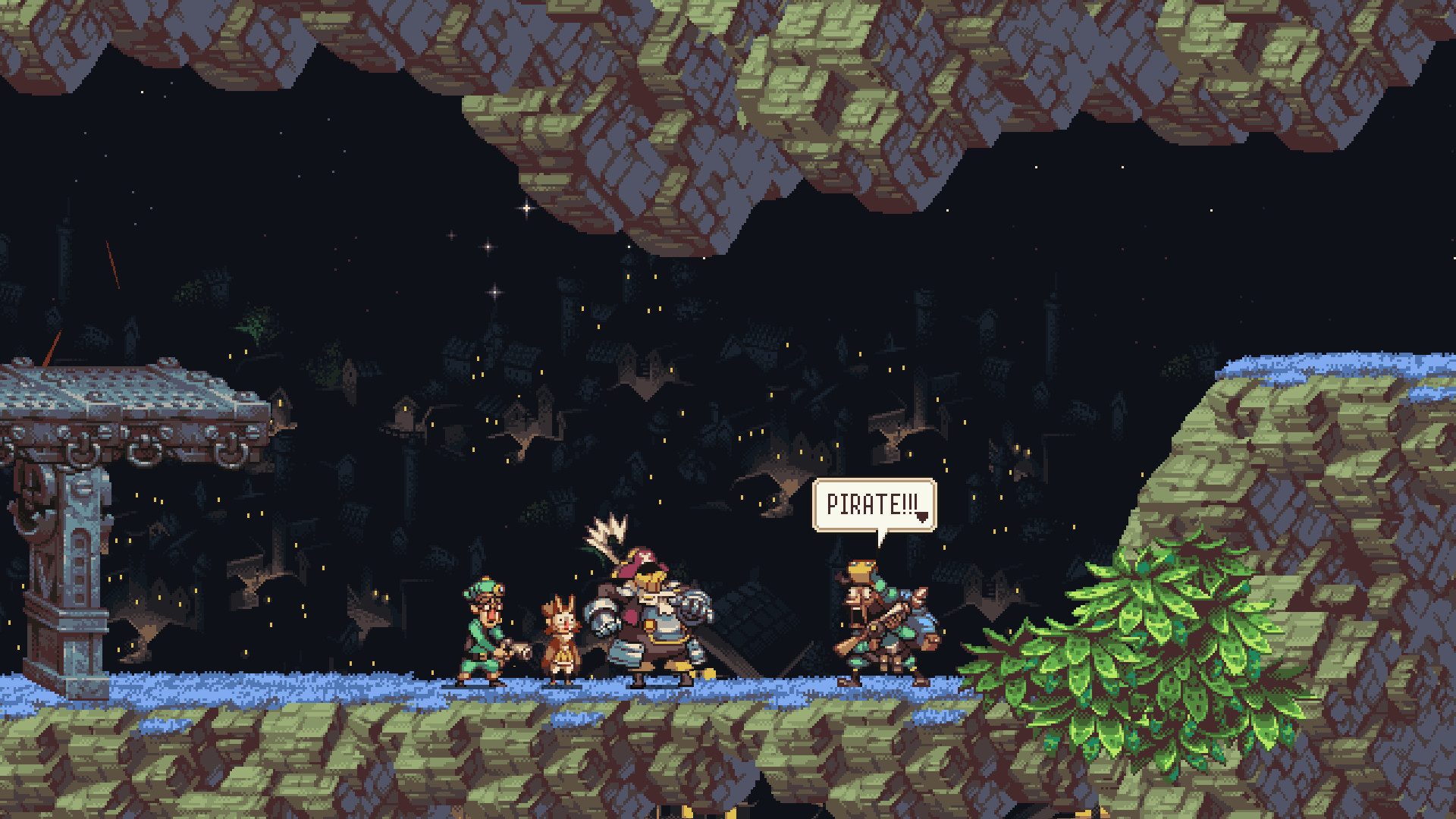
Otus lives in Vellie, a floating settlement outside the capital city of Advent. He is mute, and the game establishes early that this is a disappointment to the owls around him. Asio, his mentor, sends him on a patrol; the patrol is a formality.
The pirates attack while Otus is underground in Vellie Cave. Twig, a local troublemaker, has lured him there on Dirk's instructions, and the distraction lets the pirates steal Vellie's relic. The first act ends with the relic gone and Otus blamed, or at least treated as though he should have prevented it.
That is the game's engine: Otus is never trusted, and every success is treated as a surprise.
Part two: Tropos and the Owl Temple
Tropos is the second hub and the first taste of the wider world. The Owl Temple is an Ancient Owl ruin, abandoned after the discovery of the Loop, and it is guarded by machines the owls built. At the end of the temple, Otus recruits Alphonse, a pirate who defects after his partner Dirk goes too far.
The temple also introduces the Golden Disks, which are Aegolius's invitation to the Eternal Sanctuary, and the Book of Noctae, which frames the backstory: the Ancient Owls mastered the elements, discovered that history repeats, and built a machine to break the cycle.
Part three: Advent falls
Advent is the capital, and the game spends its quietest hour there before destroying it. Otus and Geddy are left at the school with Kernelle; Alphonse and Solus talk her into letting them out; the battle begins.
The demolition squad, Anne and Bonanza, is captured and rescued. Otus boards the pirates' ship, the Dreadnought, to sabotage its engine, and fails. Molstrom uses one of the Owl Relics and his anchor to split the city in half. The survivors flee to Vellie and Tropos, and Vellie's lower grounds become a graveyard.
This is the point where the story stops being a coming-of-age adventure. Otus has lost the city, and the game does not pretend otherwise.
Part four: the relics and the climb
After Advent, the goal changes. The relics are the only thing that can power the machine that will bring the islands down, and three factions want them: Molstrom, Solus, and Otus's group.
The climb goes through Strato, the Floating Continent and Mesos. Twig joins after his family is threatened, and his arc closes the loop opened in Vellie: the prankster who caused the first disaster helps fix the last one. The Floating Tower is the Ancient Owls' last research facility and the place where the relics are reforged into the Anti-Hex.
Part five: Solus and the Anti-Hex
Solus is the bullied student from Advent. He is also the only character who understands the Anti-Hex, and he has decided that the adults will not help him, so he makes a deal with the pirates. He is not wrong about the adults; he is wrong about the pirates.
The final fight is Solus using the relics to finish the Anti-Hex. Molstrom interrupts to take the relics back, Solus gives them to Otus, and Otus completes the machine. The islands come down. Molstrom is destroyed by the power he tried to take.
The terms, in one table
| Term | What it is |
|---|---|
| The Loop | Noctae's theory that history repeats; the reason the owls built the machine |
| Hex Machine | The device that failed and sent the landmasses into the sky |
| Owl Relics | Three artefacts that power the Hex Machine and the Anti-Hex |
| Anti-Hex | The second machine, built to bring the islands back down |
| Ancient Owls | The civilization that built the temples, Guardians and machines |
| Guardians | The machines Aegolius built to protect the temples |
What the story leaves open
The Loop is never explained. The game hints that it is about repetition, and the final scene suggests that Asio, or an ancestor of his, is part of the pattern. The Eternal Sanctuary's holograms argue about whether the Loop is provable, and Noctae's own recording admits that his predictions contradicted each other.
That ambiguity is deliberate. The endings page covers the final scene and the two readings that fit it. The characters page keeps the cast straight if you lost track during the battle.
Why the story is told this way
Otus is mute, and the game commits to it. He never narrates, never explains, and never gets a monologue at the end. Everything the player learns comes from other people talking at him, about him, or past him. That is why the story feels warmer than its plot: the emotional information is in how characters treat Otus, not in what they say about the world.
The same choice explains the game's pacing. Cutscenes are short because Otus cannot carry a scene with dialogue; the game uses environment, music and reaction shots instead. The anniversary update removed several of those scenes, but the ones it kept are the ones doing character work.
It also explains why the lore is optional. The Ancient Owls' story is told through holograms, statues and a collectible book, because Otus has no way to ask about it. Players who skip the disks get the plot; players who collect them get the history.
_Checked 2026-11-03 against the in-game dialogue as documented by the community wiki, the Book of Noctae text and the Eternal Sanctuary holograms._